
If you have ever tried to buy sleeves online and ended up with a pack that is just slightly wrong, you already know why Pokémon card dimensions matter more than people expect. A couple of millimeters off, and your cards either swim around in their sleeves or refuse to slide in at all.
his guide walks through the exact Pokémon card size, how it compares to other trading cards, what the numbers look like in every unit you would need, and how to use those same measurements to catch a fake before you pay for it.
History of Pokémon Card Dimensions
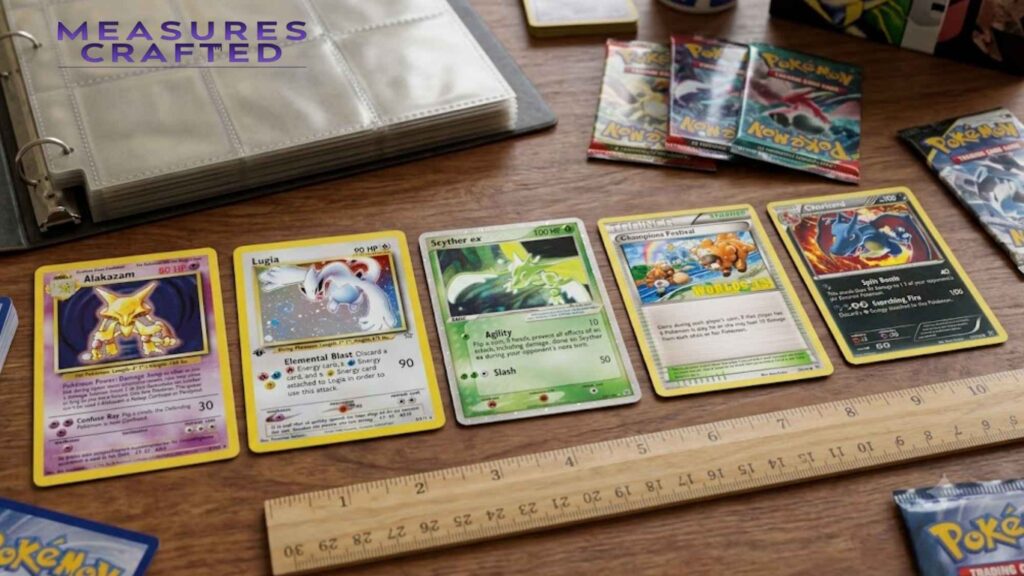
The Pokémon Trading Card Game launched in Japan in 1996, and the card size that came with it — 63.5mm × 88.9mm — has never changed since. When Wizards of the Coast brought the game to English-speaking markets in 1999 with Base Set, they kept the exact same dimensions rather than adapting them for a new region, which is why a 1999 Charizard and a 2026 pack pull still fit in the same sleeve.
That consistency was not an accident. The standard Pokémon card size matches the poker-size format already used across most trading card games, so manufacturers producing sleeves, binders, and toploaders for the broader hobby did not need to build separate tooling just for Pokémon.
Card thickness and corner-cutting technology have improved over the decades, giving modern cards a slightly sturdier feel than the thinner stock used in the late 1990s, but the width and height have stayed locked to the original spec through every generation of sets.
Read more about, 5 Inches Explained with 15 Everyday Objects
Pokémon Card Dimensions at a Glance
Here is the fuller spec sheet in one place:
| Measurement | Value |
|---|---|
| Width | 2.5 in / 63.5mm / 6.35cm |
| Height | 3.5 in / 88.9mm / 8.89cm |
| Thickness | ~0.012 in / 0.3mm (about 35pt) |
| Corner radius | ~0.125 in / 3mm |
| Weight | Roughly 1.9 grams per card |
This size has not changed since the Pokémon Trading Card Game launched in 1996. Every set since then, from Base Set to the newest expansions, sticks to the same official dimensions. That consistency is exactly why a nine-pocket binder page from 1999 still fits a card pulled from a 2026 booster pack.
One quick note before you shop for supplies: you will see slightly different numbers floating around — some sites round to 63mm, others quote 63.5mm. Both are correct. The rounded figure is just easier to say out loud; the precise conversion is what sleeve manufacturers and grading companies actually use.
Full Pokémon Cards Measurement Breakdown by Unit
Different countries and industries default to different units, so here is the same card dimensions laid out across every unit you are likely to run into:
| Unit | Width | Height |
|---|---|---|
| Inches | 2.5 in | 3.5 in |
| Fractional inches | 2 1/2 in | 3 1/2 in |
| Millimeters | 63.5 mm | 88.9 mm |
| Centimeters | 6.35 cm | 8.89 cm |
| Meters | 0.0635 m | 0.0889 m |
| Feet | 0.208 ft | 0.292 ft |
Read more about, Coke Can Dimensions: The Complete Size Guide for Every Format
American collectors and hobby shops almost always talk in inches, and you will see the fractional form (2 1/2 × 3 1/2) on older product packaging and in printed rulebooks. European manufacturers building binder pockets and sleeve molds work in millimeters, since a single millimeter of tolerance can mean the difference between a snug fit and a card that slides loose.
Feet and meters rarely come up in everyday collecting, but they are worth having on hand if you are calculating shelf space for a large binder collection or working from a design spec that defaults to metric. If you are ordering sleeves from an overseas retailer, converting to millimeters first will save you a return shipment.
Grading companies like PSA and BGS also work in millimeters when checking centering. A card that sits even a millimeter off-center on one edge would not get automatically rejected, but it will affect the final grade. That is part of why exact trading card dimensions matter beyond just “does it fit in a sleeve.”
Digital & Print Dimensions
Anyone designing custom card art, printing proxies, or building a digital canvas for fan art needs pixel numbers, not inches. Here is where most guides stop short, so let’s actually break it down.
Pokémon Cards Dimensions in Pixels by Resolution
| DPI | Width (px) | Height (px) | Best Use |
|---|---|---|---|
| 72 DPI | 180 px | 252 px | Web previews, thumbnails |
| 150 DPI | 375 px | 525 px | Casual digital mockups |
| 300 DPI | 750 px | 1050 px | Print-quality artwork |
300 DPI is the number you want if the file is ever going to a physical printer. Anything lower will look soft or pixelated once it is out of a card, since print resolution demands far more detail per inch than a screen does.
Print Bleed Size for Pokémon Cards
Discover more about, How Long Is 8 Inches? 20 Everyday Comparison That Make it easy
If you are printing custom cards or proxies, do not design right up to the edge. Add a print bleed of about 0.125 inches on every side, which brings the full canvas at 300 DPI up to 825 px by 1125 px. The bleed gets trimmed off during cutting, so it protects your design from ending up with a stray white edge if the cut shifts by a hair.
Pokémon Card Dimensions for Procreate
If you are working in Procreate, set your canvas to match whichever figure fits your project — the plain 300 DPI size for a simple design, or the bleed-inclusive size from above if the file is heading to a printer. Procreate handles either canvas size without issue, and it is generally safer to start bigger and crop down later than to discover mid-project that your layout does not leave room for trimming.
Pokémon Card Sizes Beyond Standard
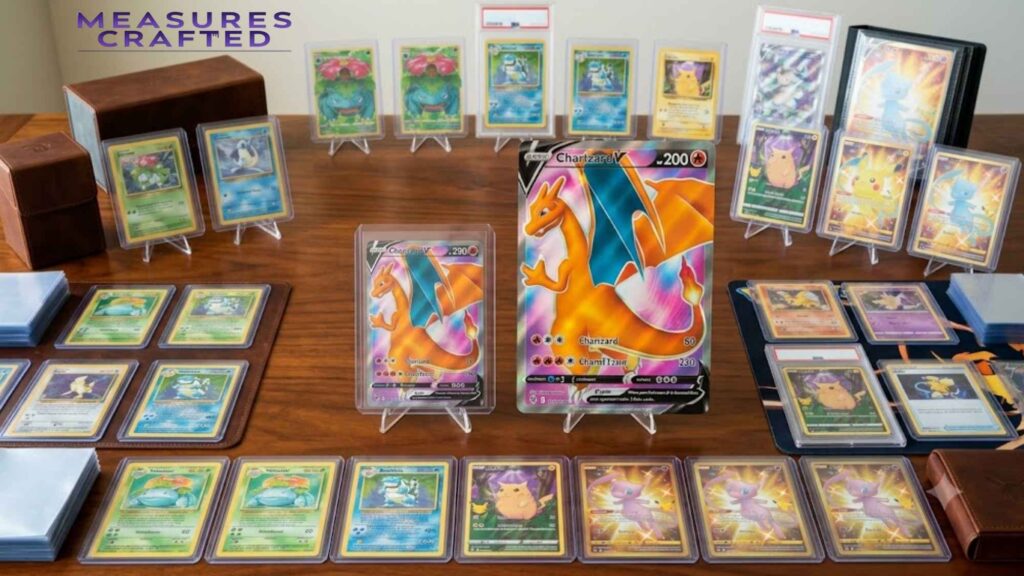
Not every card follows the standard size. A few variants exist, mostly aimed at collectors rather than players.
Check out our guide on, How Big Is a Monster Can? Dimensions, Sizes, and Comparisons
Jumbo Pokémon Cards
Jumbo Pokémon cards are oversized promotional pieces, typically landing somewhere around 5 inches by 7 inches, with some special releases stretching closer to 6 × 8 inches. These show up as convention giveaways, prize packs, or promotional bundles, and they are not legal for tournament play — they exist purely as display pieces. If you are storing one, you will need oversized sleeves or a display case built specifically for large format cards, since standard sleeves would not come close to fitting.
Other Oversized Promo Cards
Beyond jumbo cards, certain oracle-style or display-only promo cards get produced for retail launches and special events. These follow no single fixed size, so always check the listing or packaging before ordering protection for one.
Visual Size Comparisons
Numbers on a page do not always click until you compare them to something you are already holding. Here is how a Pokémon card size stacks up against a few everyday objects.
A standard credit card measures 3.37 × 2.125 inches — so a Pokémon card is noticeably taller but a bit narrower. Lay them side by side and the credit card looks short and wide next to the card’s tall, narrow shape.
A standard playing card shares almost the exact same footprint as a Pokémon card, since both follow the poker-size format. This is actually the most useful comparison of the bunch, because it explains why Pokémon cards fit so easily into standard card sleeves designed for poker and bridge decks.
A standard smartphone is roughly 3 to 3.5 times taller than a Pokémon card and about twice as wide, depending on the model. If you have ever set a card down next to your phone to snap a listing photo, you have already made this comparison without realizing it.
See also, 20 Things That Are 18 Inches Long With Real-World Examples
Do Japanese Cards Differ in Size?
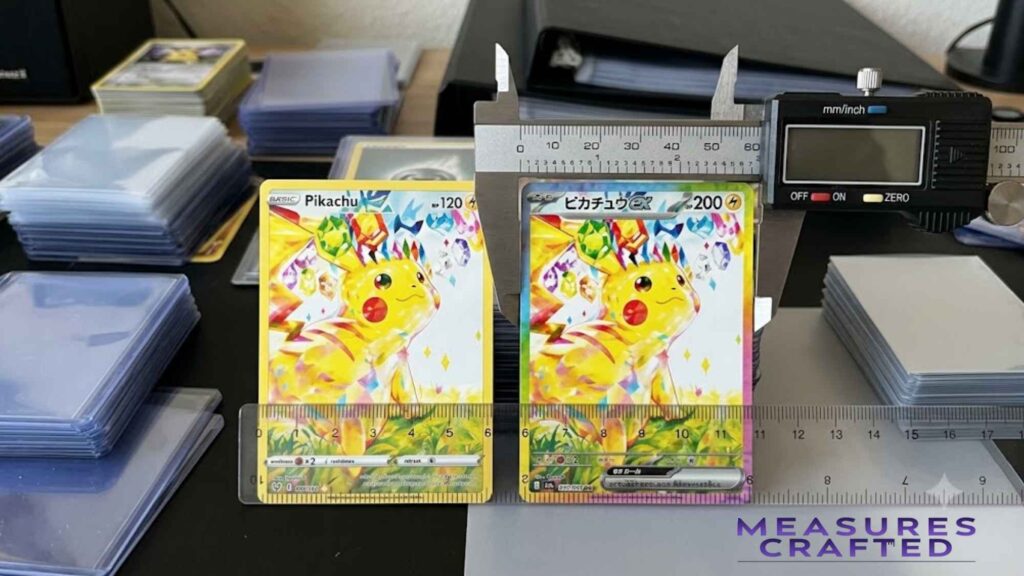
No — Japanese Pokémon cards use the exact same 63.5mm × 88.9mm spec as English-language cards. There is no regional size variation within the Pokémon TCG itself.
The confusion usually comes from a different game entirely. Yu-Gi-Oh! cards, which are also produced in Japan, measure a slightly smaller 59mm × 86mm. Someone picks up a pack of “Japanese sleeves” sized for Yu-Gi-Oh! and assumes it applies to Pokémon too, and that is where the mismatch starts. If you are shopping for Pokémon card sleeves and see a listing labeled “Japanese size,” double-check whether it is actually meant for Pokémon or for a smaller card game before adding it to your cart.
Sleeves, Toploaders & Storage Fit
Getting your Pokémon card sleeves and hard storage right comes down to matching a few extra millimeters of clearance around that base 63.5 × 88.9mm card.
| Product | Dimensions | Notes |
|---|---|---|
| Standard outer sleeve | 66.7mm × 92.1mm | Most common sleeve size, some wiggle room |
| Perfect-fit inner sleeve | 64mm × 89.9mm | Snug fit, used for double-sleeving |
| Toploader | 66.7mm × 95.3mm | Rigid protection for valuable cards |
| Card saver / semi-rigid holder | Varies by brand | Thinner alternative to toploaders |
Want to learn more? 20 Everyday Things That Are 10 Inches Long
Double-sleeving — using a perfect-fit inner sleeve underneath a standard outer sleeve — is the go-to method for anyone protecting a card worth grading or reselling. The inner sleeve hugs the card tightly to block dust and moisture, while the outer sleeve adds a second layer of edge protection without letting the card shift around inside.
One thing worth remembering: never force a card into a sleeve that is too tight. It seems like it would offer better protection, but a too-tight sleeve actually causes edge wear over time as you repeatedly slide the card in and out.
How Pokémon Cards Compare to Other Trading Cards
Here is how the Pokémon TCG stacks up against other major trading cards by size:
| Card Game | Dimensions | Compatible with Pokémon sleeves? |
|---|---|---|
| Pokémon | 63.5mm × 88.9mm | — |
| Magic: The Gathering | 63.5mm × 88.9mm | Yes — identical size |
| Yu-Gi-Oh! | 59mm × 86mm | No — noticeably smaller |
| Standard sports cards (baseball, basketball) | 63.5mm × 88.9mm | Yes — same poker-size format |
Magic: The Gathering shares the exact same footprint as Pokémon, which is why collectors who play both games can use identical sleeves and binders across their entire collection. Yu-Gi-Oh!, on the other hand, runs smaller on both dimensions, so a sleeve built for Yu-Gi-Oh! will leave a Pokémon card loose and prone to shifting.
Using Dimensions to Spot Fake Pokémon Cards
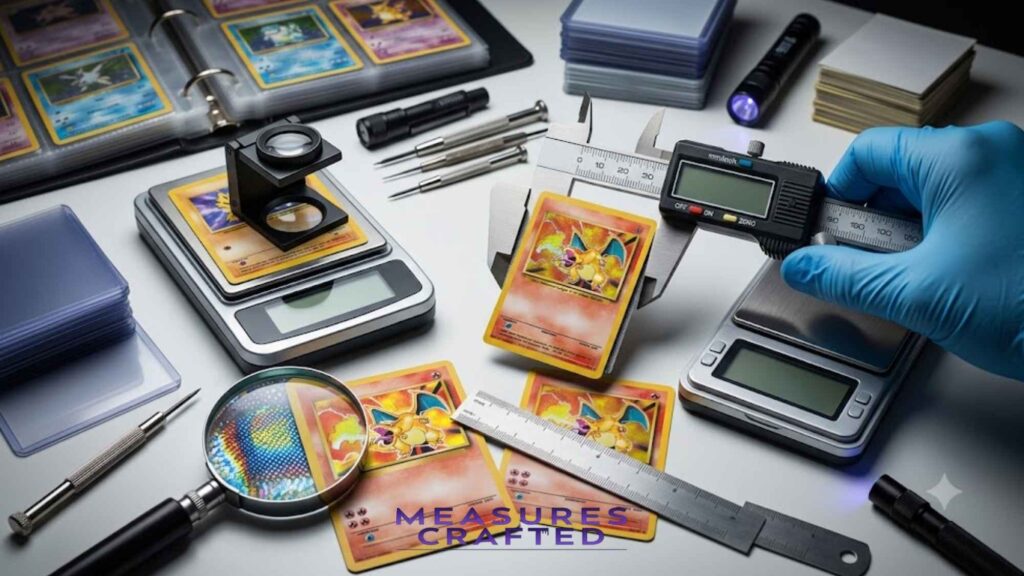
Fake Pokémon cards are common enough that measurement checks have become one of the fastest ways to catch a counterfeit before you even flip the card over. Here is a practical checklist:
Curious about this? How Long Is 11 Inches? 25 common Things And Conversion Guide
- Width and height — A genuine card sits at exactly 2.5 × 3.5 inches. Counterfeits are often slightly off, either a bit narrower or noticeably taller, since bootleg print runs rarely use factory-precise cutting dies.
- Thickness — Authentic cards run around 0.012 inches (35pt). Fakes frequently feel thinner and flimsier, or occasionally thicker if printed on the wrong stock.
- Weight — A real card weighs close to 1.9 grams. A stack of ten fakes will often feel noticeably lighter or heavier than ten genuine cards side by side.
- Corner radius — Genuine cards have a consistent, gently rounded corner. Fakes sometimes have sharper, more angular corners from cheaper die-cutting equipment.
“Fakes often vary slightly. Genuine ones stick to exact measurements for authenticity.”
Beyond pure measurement, two quick non-dimensional checks help confirm what your ruler already told you. The light test — holding the card up to a bright light source — reveals whether the card has the right layered opacity; real cards block light evenly, while fakes often show uneven, blotchy patches. Texture is the other tell: genuine holo cards have a distinct card-stock feel and printing texture that is hard for counterfeiters to replicate exactly.
How to Measure a Pokémon Card Without Calipers
You do not need lab equipment to do a rough size check at home. A few practical options:
- Use a ruler app on your phone — most give a close enough reading for a basic verification.
- Compare directly against a known object — lay the card next to a standard credit card or a playing card you know is genuine; any obvious size mismatch will be visible immediately.
- Use printer paper as a reference edge — standard letter paper has a known, fixed width, so lining a card up against the edge can help you spot if something’s noticeably off.
- Check against a sleeve you know fits — if the card is loose or too tight in a sleeve that normally fits your other cards perfectly, that is a strong hint something’s wrong with the card’s size.
None of these methods replace a caliper for precise grading work, but they are more than enough to flag a card that is worth a closer look before you buy or trade for it.
Learn more about, Dead Sea Dimensions: Full Picture Behind World’s Saltiest Lake
Test Your Knowledge: Pokémon Card Dimensions
1. What are the exact dimensions of a standard Pokémon card in inches?
A) 2.25 × 3.25 in B) 2.5 × 3.5 in C) 2.75 × 3.75 in D) 3 × 4 in
2. What is the standard Pokémon card thickness, roughly?
A) 0.012 in (0.3mm) B) 0.05 in (1.3mm) C) 0.001 in (0.03mm) D) 0.1 in (2.5mm)
3. Which unit do grading companies like PSA and BGS use when checking card centering?
A) Inches B) Centimeters C) Millimeters D) Points
4. At 300 DPI, what are the pixel dimensions of a print-ready Pokémon card canvas (no bleed)?
A) 180 × 252 px B) 375 × 525 px C) 750 × 1050 px D) 825 × 1125 px
5. How much print bleed should you add per side when designing custom card art?
A) 0.05 inches B) 0.125 inches C) 0.25 inches D) 0.5 inches
6. Roughly how big are jumbo Pokémon promo cards?
A) 3 × 4 inches B) 4 × 5 inches C) 5 × 7 inches D) 8 × 10 inches
7. How do Japanese Pokémon cards compare in size to English-language cards?
A) Japanese cards are smaller B) Japanese cards are larger C) They are the same size D) Size varies by set
8. Which trading card game uses a noticeably smaller card size than Pokémon?
A) Magic: The Gathering B) Yu-Gi-Oh! C) Standard baseball cards D) All of them are the same size
Answers:
- B
- A
- C
- C
- B
- C
- C
- B
Conclusion
Getting the measurements right pays off in small, practical ways: sleeves that actually fit, a print file that does not get cropped wrong, and a faster gut-check the next time you are handed a card that does not quite feel right. None of it requires special equipment — a ruler, a known reference object like a credit card, or a sleeve you already trust will get you most of the way there.
Bookmark the table above, and you have got everything you need on hand for buying supplies, printing custom art, or double-checking a card before it changes hands.
FAQs About Pokémon card
Got questions? Find quick and helpful answers below.
1. What is the most expensive Pokémon card ever sold?
That title belongs to a PSA 10 Pikachu Illustrator, which sold for $16.49 million through Goldin Auctions in February 2026. The card was auctioned by Logan Paul, and a Guinness World Records judge certified it as both the most expensive Pokémon card and the most expensive trading card ever sold at auction.
2. What makes a “first edition” card different from an unlimited one?
First edition cards carry a small “1st Edition” stamp near the set symbol, printed only during the earliest print run of a set before it went to mass, unlimited printing. Because the first print run was much smaller, first edition copies of early sets (especially 1999 Base Set) carry a significant value premium over their unlimited counterparts.
3. What is the difference between PSA, BGS, and CGC grading?
BGS offers subgrades that break out centering, corners, edges, and surface separately, appealing to collectors who want detailed condition data, while CGC is newer to sports cards but is best known for Pokémon and TCG grading. PSA still commands the highest resale premiums, with a PSA 10 typically selling for 10-30% more than an equivalent grade from another company, mainly due to brand-driven buyer preference.
Interested in learning more? Things That Are 5 Centimeters Long: Real-Life Comparisons

Hi, I’m Adam Nicholas, and I lead the Dimensions category here at Measures Crafted. I love breaking down height, width, and depth into comparisons that actually click — because a number on its own rarely tells the full story. My goal is to help you see the bigger picture, quite literally, so every dimension makes sense the moment you read about it.