

Pick up a can of Red Bull, and you’ll notice something right away: it doesn’t feel like a regular soda can. It’s slimmer, taller, and sits differently in your hand.
This guide breaks down every official Red Bull can size, with exact Red Bull can measurements in inches, centimeters, and millimeters. You’ll find the height, diameter, and circumference for each format, how they stack up against Monster and standard soda cans, and whether a given can will actually fit your cup holder, cooler, or backpack side pocket. No guesswork, no filler — just the numbers you came here for.
Quick Conversion Chart for Every Red Bull Can Size
Here’s the fast answer before we get into the details. This table covers Red Bull can dimensions in inches, Red Bull can dimensions in cm, and millimeters side by side, so you don’t have to do the math yourself. Every raw figure in this article traces back to this one chart — later sections build on these numbers rather than repeating them.
| Can Size | Volume | Height (in / cm / mm) | Diameter (in / cm / mm) |
|---|---|---|---|
| 8.4 fl oz | 250 mL | 5.27 in / 13.4 cm / 134 mm | 2.09 in / 5.3 cm / 53 mm |
| 12 fl oz | 355 mL | 6.3 in / 16.0 cm / 160 mm | 2.24 in / 5.7 cm / 57 mm |
| 16 fl oz | 473 mL | 6.9 in / 17.5 cm / 175 mm | 2.52 in / 6.4 cm / 64 mm |
| 20 fl oz | 591 mL | 7.5 in / 19.1 cm / 191 mm | 2.6 in / 6.6 cm / 66 mm |
A quick note on accuracy: Red Bull doesn’t publish official tooling blueprints for public use, so these figures come from standard aluminum beverage can tooling data and cross-checked physical measurements.
The 8.4 fl oz figures are the most reliable of the bunch, since that’s the industry-standard “slim” can format (202/50 in can-maker shorthand) used across the beverage industry, not just by Red Bull.
Red Bull’s Four Official Can Formats
Red Bull sells four Red Bull can sizes in most global markets, and each one serves a slightly different purpose. Rather than just scaling the same can up and down, the brand widens the diameter slightly as the height increases — a design choice we’ll unpack later in this guide.
Interested in learning more? Dead Sea Dimensions: Full Picture Behind World’s Saltiest Lake
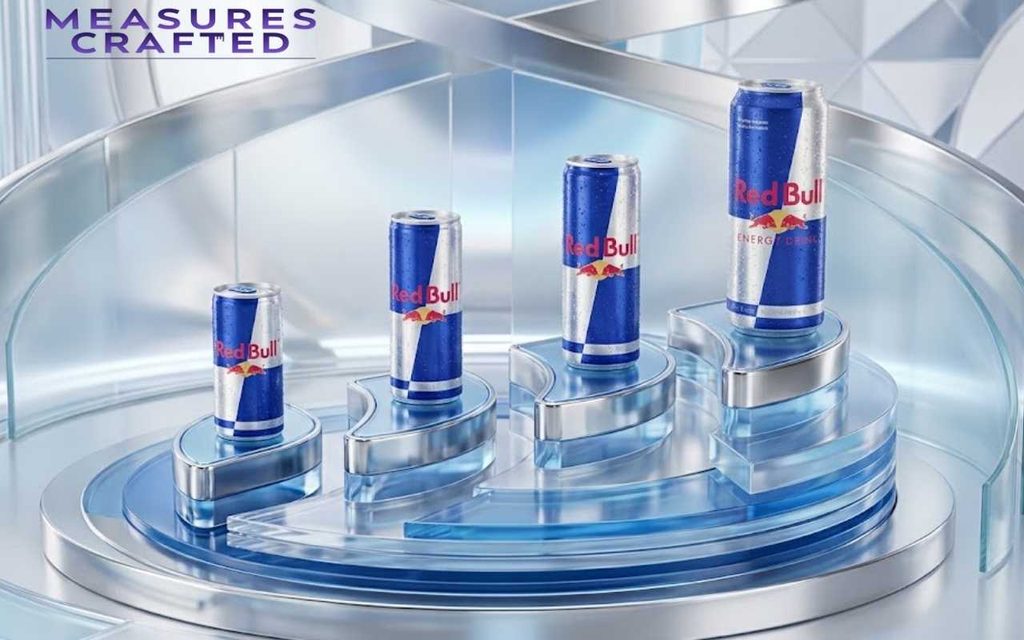
8.4 fl oz Red Bull Can — The Original Slim Can
This is the can that started it all back in 1987, and it’s still the most recognizable format on shelves today. The standard Red Bull can (see the chart above for exact figures) helped define what an energy drink was supposed to look like, at a time when most competing beverages still shipped in short, wide containers built for soda.
Ask people why they think Red Bull feels “stronger” than other drinks in the same size class, and most will mention the can’s shape before they mention the recipe — perception does a lot of work here, independent of what’s actually inside.
This size shows up in single cans, 4-packs, and 24-can cases, and it’s the version most commonly used for pricing comparisons across the energy drink category.
12 fl oz Red Bull Can — The Everyday Size
Roughly 50% more volume than the original, the standard Red Bull can size steps up here without losing the brand’s signature slim profile. This is a 355 mL format, and it’s become the default option in a lot of US convenience stores, largely because it hits a sweet spot between portability and value.
16 fl oz Red Bull Can — The Tall Can
This size is aimed at longer sessions — think study marathons, night shifts, or pre-workout routines where one small can won’t cut it. Because the shape stays proportional rather than just stretching taller, it doesn’t feel unstable or top-heavy in hand, despite holding nearly double the original can’s volume.
20 fl oz Red Bull Can — The Largest Format
The biggest Red Bull can size on the market. You’ll mostly find it in single-serve coolers at gas stations and convenience stores rather than in multipacks, since it’s positioned as a grab-and-go option for people who want maximum volume in one purchase.
Red Bull Can Height, Diameter, and Circumference Explained
“Size” actually breaks down into three separate numbers, and each one matters for a different reason.

Discover more about, 21 Everyday Objects That Show You Exactly How Big 2 Inches Is
Red Bull can height and Red Bull can diameter are covered in full in the chart above. What’s worth noting is the pattern: looking at the full lineup side by side, the gap between the smallest and largest can is bigger than the volume difference alone would suggest.
That’s because Red Bull widens the can as it grows taller, instead of just stretching one shape further and further. A can that only got taller without adding any width would look disproportionately thin and stand less steadily on its own.
Diameter also gives you the radius for free — just cut it in half. That’s the number you’ll want if you’re calculating internal volume or checking clearance on a mounted can holder that specifies radius rather than full width.
Red Bull can circumference is where a lot of people get tripped up, because it’s easy to confuse with diameter. Circumference is the distance around the can, not across it:
Circumference = π × diameter
Here’s how that plays out across the lineup — figures not covered anywhere else in this guide:
| Can Size | Circumference (in / mm) |
|---|---|
| 8.4 fl oz | 6.57 in / 167 mm |
| 12 fl oz | 7.03 in / 179 mm |
| 16 fl oz | 7.92 in / 201 mm |
| 20 fl oz | 8.17 in / 207 mm |
This number matters most for anyone designing wraparound labels, custom sleeves, or koozies — get the circumference wrong, and the material either overlaps sloppily or doesn’t quite meet.
Metric or Imperial? Getting the Conversions Right

If you’re switching between Red Bull can in inches and Red Bull can in cm, a couple of common mistakes trip people up.
First, don’t round too early. If you round a measurement to one decimal place before converting, then multiply, the error compounds — a can that’s actually 5.27 inches becomes “5.3 inches,” and that small rounding slip carries through every calculation downstream.
Second, remember that 1 inch equals exactly 2.54 cm, not 2.5 cm; that 0.04 difference sounds tiny, but across a full case of cans stacked end to end, it adds up fast.
Check out our guide on, How Long Is 500 Feet? 19 Real-World examples You Can Picture
Here’s the quick reference:
- Inches to cm: multiply by 2.54
- Cm to inches: divide by 2.54
- Mm to inches: divide by 25.4
- Inches to mm: multiply by 25.4
Which unit you reach for usually depends on what you’re doing with the number. Packaging designers and manufacturers tend to work in millimeters, since that’s the standard for tooling specs and print templates.
Everyday shoppers checking cup holder or fridge shelf fit are more likely to think in inches. If you’re building something that needs to hold the can precisely, always work in millimeters and convert to inches at the end, rather than the other way around — starting from a rounded inch measurement and converting to mm tends to introduce the kind of drift mentioned above.
Putting the Size in Perspective

Numbers on a page don’t always translate into a sense of scale, so here’s how the energy drink can dimensions compare to a few things you probably have nearby right now:
- The 12 fl oz can stands about as tall as an average smartphone, give or take a few millimeters depending on the model.
- The 20 fl oz can’s width lines up closely with a standard tennis ball.
- A deck of playing cards, stood on its short edge, is noticeably shorter than even the smallest Red Bull can.
- The tallest can in the lineup is close in length to an unsharpened #2 pencil — a genuinely useful mental benchmark if you don’t have a ruler handy.
Will It Actually Fit? Practical Compatibility Checks
This is the part most size guides skip, and it’s arguably the most useful one.
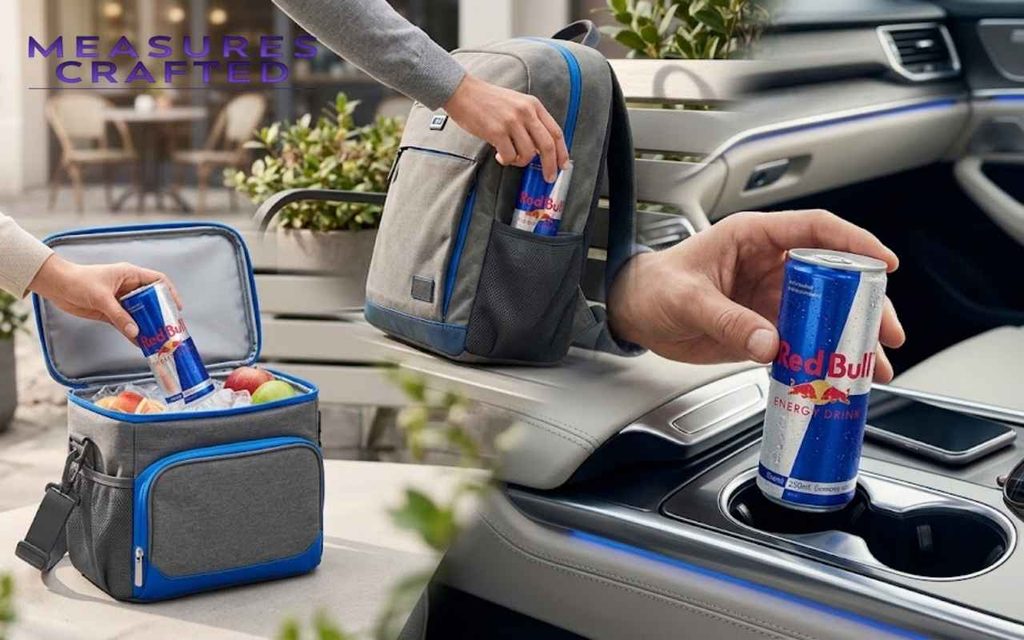
Red Bull Cup Holder Fit
Most car cup holders are designed with enough clearance for cans well beyond Red Bull’s widest format, which is why Red Bull cup holder fit is rarely an issue — even the largest can slides in without a problem in the vast majority of vehicles.
The smallest can, on the other hand, can actually feel a little loose in a wide, adjustable cup holder, since it doesn’t fill the gap as snugly as a standard soda can would.
Vending Machine Compatibility
Vending machines built for standard soda cans generally accommodate the full height and width range of Red Bull’s lineup without issue. Older machines calibrated strictly for classic soda can proportions may reject the largest format, though — worth checking before assuming every machine stocks every size.
Coolers, Bags, and Mini-Fridges
Because the cans stay narrow relative to their height, they pack efficiently into tall, slim spaces — think backpack side pockets, door shelves in a mini-fridge, or the narrow gap along the edge of a cooler. As a rough packing guide:
- A standard 24-can cooler fits roughly 24–28 cans of the smallest size, depending on ice space
- The same cooler holds closer to 18–20 cans of the largest size, simply because each can takes up more volume
See also, How Small Is 2mm? 17 Real-World Examples to Compare
Red Bull Size Comparison: How It Measures Against Other Energy Drinks
Comparing Red Bull with other drinks shows how its slim shape differs from wider cans.
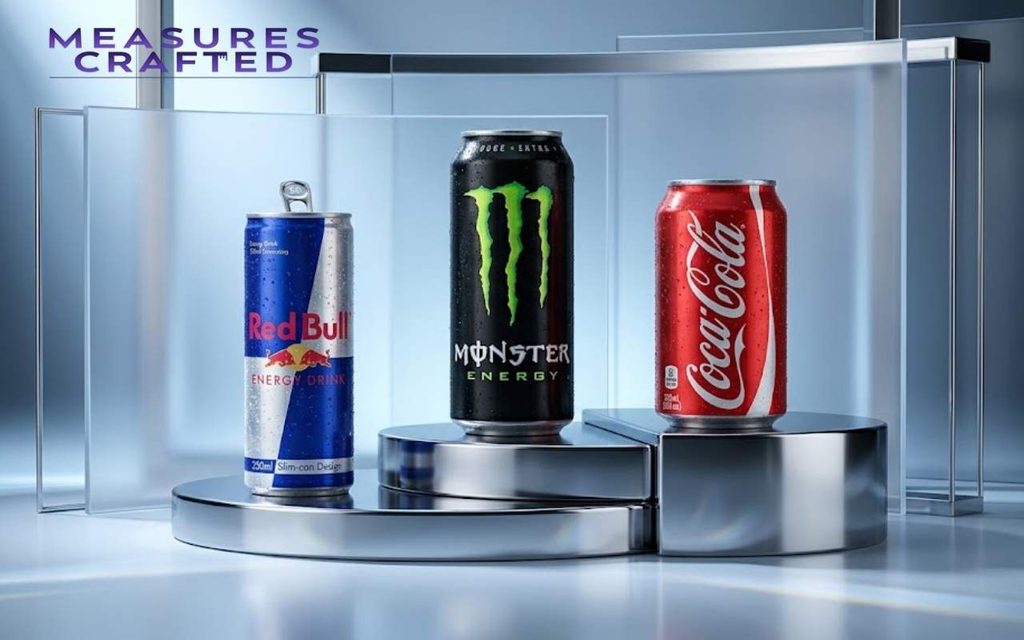
Red Bull vs Monster Energy Can
A Red Bull vs Monster comparison comes down to shape philosophy as much as size. Monster’s standard can is a wider, shorter cylinder — closer to a traditional soda can shape — while Red Bull leans into the narrow, elongated profile across every size it sells. Here’s a direct Red Bull can diameter comparison, using each brand’s 16 fl oz can:
| Metric | Monster 16 fl oz | How Red Bull Compares |
|---|---|---|
| Height | ~6.6 in (168 mm) | About 0.3 in taller |
| Diameter | ~2.55 in (65 mm) | About 0.03 in narrower |
| Shape profile | Wider, standard | Slim, elongated |
At the same volume, Monster’s can tends to sit slightly shorter and slightly wider than Red Bull’s — a small difference, but enough that the two brands feel distinct in hand even before you read the label.
Red Bull vs a Standard Soda Can
A classic 12 oz soda can (think Coca-Cola or Pepsi) measures roughly 4.83 inches tall with a 2.6-inch diameter. Against Red Bull’s 12 fl oz can, the difference is obvious: Red Bull trades width for height, landing on a shape that’s almost 1.5 inches taller but noticeably narrower than the soda can standard.
Smallest vs Largest Red Bull Can
Line up the smallest and largest cans in the lineup side by side, and the size gap is bigger than most people expect. The largest can is 42% taller and 24% wider than the original, while holding 136% more liquid. It’s the clearest real-world proof of the width-scaling pattern covered earlier — volume alone doesn’t account for a gap that large.
How to Measure a Red Bull Can Yourself
If you want to verify any of these numbers with a can in hand, here’s a simple, accurate method.

Measure the Height
Stand the can upright on a flat surface. Place a ruler or tape measure flat against the side, starting at the base and reading straight up to the top of the lid — not the tab, just the flat metal surface. Avoid measuring at an angle, which is the most common source of error here.
Measure the Diameter
Lay the can on its side and measure straight across the widest point, which is usually near the middle of the can’s body rather than at the top or bottom, where it tapers slightly. Calipers give the most precise reading, but a ruler works fine for general purposes.
Measure the Circumference
Wrap a flexible tape measure or a strip of paper snugly around the can’s body, mark where it overlaps, then measure that length. No flexible tape on hand? Use the diameter-to-circumference formula covered earlier instead — it’ll get you within a millimeter or two of the real number.
Red Bull Can Dimensions: Quick Quiz
Test what you learned about Red Bull can sizes, measurements, and comparisons.
Want to learn more? 18 Everyday Things That Are About 9 Inches Long
1. What is the height of a standard 8.4 fl oz Red Bull can?
A) 4.83 inches
B) 5.27 inches
C) 6.3 inches
D) 7.5 inches
2. Which formula do you use to calculate a can’s circumference from its diameter?
A) Diameter ÷ π
B) Diameter × π
C) Diameter² × π
D) Diameter × 2
3. How does the Red Bull 12 fl oz can compare to a standard 12 oz soda can?
A) It’s shorter and wider
B) It’s the exact same shape
C) It’s taller and narrower
D) It has a larger diameter but the same height
4. Roughly how much taller is the 20 fl oz Red Bull can than the 8.4 fl oz can?
A) About 10%
B) About 42%
C) About 75%
D) About 100%
5. Why do car cup holders rarely cause a fit problem with Red Bull cans?
A) All Red Bull cans are exactly 3 inches wide
B) Most cup holders accommodate 2.5–3 inches in diameter, which covers every Red Bull size
C) Red Bull cans are designed to be squeezed into any holder
D) Cup holders are only made for slim cans
Answers:
- B — 5.27 inches
- B — Diameter × π
- C — Taller and narrower
- B — About 42%
- B — Most cup holders accommodate 2.5–3 inches in diameter
Conclusion
Understanding Red Bull can dimensions makes it easier to compare different sizes and choose the right one for your needs. From checking cup holder compatibility to planning storage space or creating custom can sleeves, these measurements provide a useful starting point. Keep the size chart handy for quick conversions, and remember that actual can dimensions may vary slightly between versions and markets.
Frequently asked questions
Here are quick answers to common questions about Red Bull can sizes and measurements.
Do all countries sell the same Red Bull can sizes?
Not exactly. The 250 mL can is close to universal, but availability of the larger formats varies by market, and some regions offer additional variants, like a sugar-free option with slightly different can specifications.
How much does an empty Red Bull can weigh?
Roughly 8 to 15 grams empty, depending on the size — the smallest can weighs around 8.1 grams, while the largest comes in closer to 14.6 grams, reflecting the extra aluminum needed for the bigger format.
Does the can shape affect how the drink tastes or stays carbonated?
Not meaningfully. Carbonation retention depends far more on seal quality and how quickly the can is consumed once opened than on the diameter or height of the container itself. A narrower can does chill slightly faster than a wide one, though, since more of the liquid sits closer to the outer surface — useful to know if you’re in a hurry to cool one down in ice.
Curious about this? How Big Is 1 Inch? 18 Everyday items That Show you How Big It Is

Hi, I’m Adam Nicholas, and I lead the Dimensions category here at Measures Crafted. I love breaking down height, width, and depth into comparisons that actually click — because a number on its own rarely tells the full story. My goal is to help you see the bigger picture, quite literally, so every dimension makes sense the moment you read about it.